A good morning does not require waking up at 5 a.m., taking an ice bath, meditating for an hour, or completing a two-page list of habits before breakfast.
The best morning routine checklist is one you can realistically follow on an ordinary day—even when you are tired, busy, or running short on time.
A practical morning routine should help you move from sleep into your day with less rushing and fewer decisions. It can include simple habits such as getting up at a consistent time, getting some daylight, drinking water, getting ready, moving your body, eating if you need to, and deciding what matters most that day.
The important part is not how impressive the routine looks. Consistency and practicality matter more than complexity.
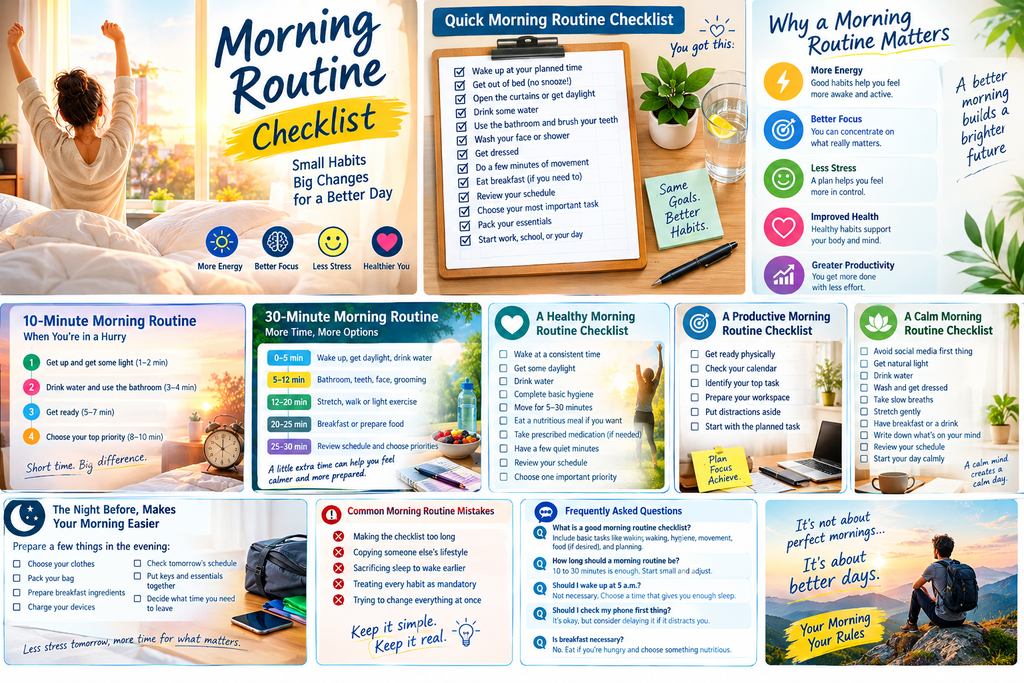
Quick Morning Routine Checklist
If you want a checklist you can save or print, start here:
- ☐ Wake up at your planned time
- ☐ Get out of bed instead of repeatedly snoozing
- ☐ Open the curtains or get outside for daylight
- ☐ Drink some water
- ☐ Use the bathroom and brush your teeth
- ☐ Wash your face or shower
- ☐ Get dressed
- ☐ Do a few minutes of stretching, walking, or other movement
- ☐ Eat breakfast if it works for you
- ☐ Review your schedule
- ☐ Choose your most important task
- ☐ Pack your essentials
- ☐ Start work, school, or your first planned activity
You do not have to complete every item every morning. Think of this as a menu from which you can build a routine that fits your life.
What Is a Morning Routine Checklist?
A morning routine checklist for adults is a short sequence of tasks you complete after waking up to prepare yourself physically and mentally for the day.
Instead of deciding what to do every morning, you already have a basic sequence to follow. This can reduce unnecessary decisions and make your morning more predictable.
For example:
Wake → daylight → water → hygiene → movement → food → planning → start the day
There is no universally correct order. Your work schedule, family responsibilities, commute, health needs, culture, and personal preferences all affect what makes sense.
A useful checklist should describe your actual morning, rather than copying an influencer’s routine.
Why a Simple Routine Often Works Better
Many morning-routine lists fail because they are too ambitious.
Someone may create a checklist containing meditation, journaling, a long workout, reading, meal preparation, skincare, cold exposure, planning, cleaning, and several other activities. It sounds productive, but a routine that requires an hour or more can become difficult to maintain.
A shorter checklist has an important advantage: you can still use it when life gets busy.
Recent morning-routine content increasingly emphasizes realistic routines rather than a mandatory 5 a.m. start. Current examples commonly focus on a small number of repeatable actions such as waking, light exposure, hydration, movement, preparation, and planning.
The goal is not to win a productivity competition. The goal is to start your day without unnecessary chaos.
The 10-Minute Morning Routine
Some mornings simply do not allow enough time for a long routine.
Try this version when you are in a hurry:
Minutes 1–2: Get up and get some light
Turn off the alarm, get out of bed, open the curtains, or step outdoors if practical.
Morning light is relevant to the body’s circadian system, and appropriately timed morning light can influence circadian timing and daytime alertness.
Minutes 3–4: Drink water and use the bathroom
Have some water if you are thirsty, then take care of basic hygiene.
You do not need to force yourself to drink a huge amount of water immediately after waking.
Minutes 5–7: Get ready
Brush your teeth, wash your face, get dressed, and handle whatever basic grooming you normally need.
Minutes 8–10: Choose the day’s priority
Look at your schedule and identify the one task that matters most.
If you have somewhere to be, check that you have your phone, keys, wallet, bag, and other essentials.
That’s enough. A short routine is still a routine.
The 30-Minute Morning Routine
If you have more time, you can add movement and a calmer transition into the day.
| Time | Task |
|---|---|
| 0–5 min | Wake up, get daylight, drink water |
| 5–12 min | Bathroom, teeth, face, grooming |
| 12–20 min | Stretch, walk, or light exercise |
| 20–25 min | Breakfast or prepare food |
| 25–30 min | Review schedule and choose priorities |
The exact times are flexible. If showering takes longer or you need to prepare children for school, adjust the structure.
The point is to create a sequence, not a stopwatch competition.
Should You Exercise in the Morning?
Morning exercise can be an excellent part of a routine, but you do not have to exercise immediately after waking to be healthy.
A morning walk, mobility session, bodyweight workout, cycling session, or other activity can help you become more active and may make the transition into the day feel easier.
However, the bigger picture is your total activity across the week.
For adults, the CDC recommends at least 150 minutes of moderate-intensity physical activity per week, or 75 minutes of vigorous activity, plus muscle-strengthening activities on at least two days each week. Activity can be divided into smaller portions rather than completed in one long session.
So if you cannot fit a 30-minute workout into your morning, a 10-minute walk still gives you a reason to move—and you can get additional activity later.
Do You Need to Wake Up at 5 A.M.?
No.
There is nothing inherently magical about 5 a.m. The better target is a sleep schedule that provides enough sleep and works with your responsibilities.
Sleep regularity is important, and research has found associations between consistent sleep and wake times and better health outcomes, although the evidence does not establish one universally ideal wake-up time for everyone.
If waking at 5 a.m. means going to bed too late and cutting your sleep short, the earlier alarm may work against your goal.
Instead, ask:
“What wake-up time allows me to get enough sleep and start my day without rushing?”
That is a much more useful question.
What Should You Do Before Checking Your Phone?
You do not have to follow a strict “no phone” rule.
However, if checking notifications immediately causes you to spend 20 minutes scrolling, responding to messages, or reading stressful news, changing that habit may make your morning easier.
Try creating a small buffer:
Wake → light → water → bathroom → get dressed → phone
Or simply keep your phone away from the bed so you have to stand up to reach it.
The objective is not to make smartphones “bad.” It is to prevent your first few minutes of the day from being controlled by notifications.
Should You Eat Breakfast?
Breakfast can fit into a healthy morning routine, but there is no need to pretend that one breakfast schedule works for everyone.
Some people are hungry soon after waking. Others prefer to eat later.
If you eat breakfast, aim for a practical meal that fits your dietary needs and schedule rather than choosing an elaborate “perfect” breakfast that is difficult to prepare every day.
Easy options can include:
- Eggs with whole-grain toast
- Oatmeal with fruit and nuts
- Yogurt with fruit
- A simple sandwich
- Leftovers from a balanced meal
- A smoothie with appropriate protein and fiber
If you have a medical condition or specific nutritional requirements, follow advice from your healthcare professional rather than a generic internet checklist.
A Healthy Morning Routine Checklist
For a health-focused version, use this:
- ☐ Wake at a reasonably consistent time
- ☐ Get some natural daylight
- ☐ Drink water according to your needs
- ☐ Complete basic hygiene
- ☐ Move for 5–30 minutes
- ☐ Eat a nutritious meal if you want breakfast
- ☐ Take prescribed morning medication as directed
- ☐ Spend a few quiet minutes without unnecessary distractions
- ☐ Review your schedule
- ☐ Choose one important priority
Notice what is missing: a requirement to do everything perfectly.
A healthy routine should support your life, not become another source of stress.
A Productive Morning Routine Checklist
If your main goal is productivity, keep the routine focused.
Before work or study
- ☐ Get ready physically
- ☐ Check your calendar
- ☐ Identify today’s most important task
- ☐ Prepare your workspace
- ☐ Put distractions aside
- ☐ Begin with the planned task
Try not to turn “planning the day” into an hour-long activity.
A useful morning plan can be as simple as:
Today I must finish: ________
If I have extra time: ________
First action: ________
This gives you a clear starting point without creating another complicated productivity system.
A Calm Morning Routine Checklist
Not everyone wants a high-energy morning.
If you prefer a slower start, try:
- ☐ Wake without immediately opening social media
- ☐ Open curtains or step outdoors
- ☐ Drink water
- ☐ Wash and get dressed
- ☐ Take several slow breaths
- ☐ Stretch gently
- ☐ Have breakfast or a drink
- ☐ Write down what is on your mind
- ☐ Review the day’s schedule
- ☐ Start your first activity calmly
The American Heart Association also suggests activities such as walking, meditation, prayer, or yoga as possible ways to support mental well-being during a morning routine.
Choose something that genuinely helps you—not something you feel you are supposed to do.
The Night Before Makes Your Morning Easier
One of the biggest mistakes is trying to solve every morning problem after waking.
Prepare a few things the night before:
- Choose your clothes
- Pack your work or school bag
- Prepare breakfast ingredients
- Charge important devices
- Check tomorrow’s schedule
- Put keys and essentials in one place
- Decide what time you need to leave
This turns part of your morning routine into an evening preparation routine.
The less you have to decide while half-awake, the easier it becomes to follow your checklist.
How to Build a Morning Routine That Lasts
Start with the routine you already have.
For three or four days, pay attention to what you naturally do after waking. Write those actions down in order.
Then make three changes:
1. Keep the essentials.
Do not remove basic tasks simply because they are boring.
2. Add one useful habit.
This could be a short walk, daylight, planning, stretching, or preparing breakfast.
3. Remove unrealistic tasks.
If you repeatedly skip something, ask whether it belongs in your routine at all.
You can also create two versions:
Normal morning
A 20–30 minute routine for ordinary days.
Emergency morning
A 5–10 minute version for days when you wake up late.
This approach prevents one bad morning from destroying the entire routine.
Common Morning Routine Mistakes
Making the checklist too long
More tasks do not automatically produce a better morning.
Copying someone else’s lifestyle
A routine designed for a person who works from home may not work for someone with a long commute.
Sacrificing sleep to wake earlier
An early alarm is not useful if it regularly reduces the amount of sleep you need.
Treating every habit as mandatory
Some habits should be optional. Your checklist should have a core and a flexible section.
Trying to change everything at once
Add one or two habits first. Once they become normal, consider adding another.
Frequently Asked Questions
What is a good morning routine checklist?
A good checklist includes the basic actions you need to start your day—waking, hygiene, getting ready, some movement or daylight, food if desired, and a brief review of your priorities. The best checklist is one you can realistically repeat.
How long should a morning routine be?
There is no scientifically required length. It can take 10 minutes or considerably longer. Start with the minimum routine that prepares you for your day and expand it only if you have the time and genuinely benefit from the additional steps.
What are the 5 most important morning habits?
For a simple starting point, consider:
- Wake at a consistent time that allows adequate sleep.
- Get some morning daylight.
- Take care of basic hygiene.
- Move your body.
- Decide what you need to accomplish that day.
Not every person needs all five every morning.
Is a 5 a.m. morning routine better?
No. A 5 a.m. wake-up time is not automatically healthier or more productive. Your routine should allow adequate sleep and fit your natural schedule and responsibilities.
Should I exercise before or after breakfast?
Either can work depending on the activity, your preferences, and how your body responds. For demanding exercise or specific health conditions, individual advice from a qualified professional may be appropriate.
Should I check my phone first thing in the morning?
You can, but if notifications and social media routinely distract you, consider delaying them until after your basic morning tasks. The goal is to control your attention rather than follow an arbitrary rule.
Final Morning Routine Checklist
If you want one simple version to start tomorrow, use this:
- ☐ Wake up at your planned time
- ☐ Get some daylight
- ☐ Drink water
- ☐ Brush your teeth and wash up
- ☐ Get dressed
- ☐ Move for a few minutes
- ☐ Eat if you are hungry
- ☐ Check your schedule
- ☐ Choose your top priority
- ☐ Gather your essentials
- ☐ Start your day
You can complete the entire list quickly or give yourself more time. The checklist is a framework, not a test.
One Response